
- 3 / 7 / 30-day lead times — set by the part's complexity.
- Four in-house processes — turning, milling, mill-turn, and grinding.
- a hundred-odd machines — parallel capacity that holds the date.
- MOQ 1 piece — schedule a prototype before committing volume.

How Are These Machining Services Scheduled?
The short answer: by reading each part's process-step count, not by reciting a fixed number. The honest structure is three tiers — roughly 3 days for simple parts, 7 days for standard work, and 30 days for complex parts that run 10–20 steps or include finishing. The drawing sets the date, and the date is confirmed against the drawing before it is promised.
A service that quotes a date before seeing the file is guessing, and a guessed date is a risk to your own schedule. The discipline here is the reverse: the part is read first, the steps are counted, the capacity is checked, and only then is a date committed.
Which Machining Processes Are Offered?
The in-house range covers the metal-cutting family, which is what lets most parts be scheduled end-to-end without a subcontracted cut.
| Process | Best for | Held tolerance |
|---|---|---|
| CNC turning | Round parts — shafts, pins, bushings | ±0.002 mm |
| Swiss-type turning | Long, thin, small-diameter parts | ±0.003 mm |
| CNC milling (3/4/5-axis) | Prismatic parts — housings, brackets | ±0.003 mm (milling) / ±0.002 mm (turning) |
| Mill-turn | Turned and milled features from one datum | ±0.003 mm |
| Precision grinding | Bearing seats, roundness-critical surfaces | ±0.002 mm |
Heat treatment and surface finishing run through qualified partners and are scoped into the same order, which is exactly why a part with finishing lands in the longer tier.
Why does keeping the cut in-house matter for the schedule specifically? Because the metal-cutting steps are the part of the routing the shop controls, and control is what a date is. When the cut stays in the building, work can be re-sequenced across a hundred-odd machines the moment an order lands; when it leaves, the date now depends on someone else's queue. In-house routing is the difference between a commitment and a relay.
Why Does Finishing Push a Part Into the Long Tier?
Because finishing is a separate stage, not a step. Anodizing, plating, powder coating, and heat treatment all happen after the metal is cut, and each has its own cycle time that stacks on top of the machining schedule. A part that needs finishing therefore lands in the 30-day tier almost by definition.
The honest planning move is to name the finishing in the first message, so the schedule accounts for it up front. A supplier who discovers the finishing requirement late is a supplier who has already blown the date — the discovery should happen in the review, not in the middle of the run.
The way to test this is to watch where the finishing appears in the conversation. If the supplier asks about finishing in the first reply, the schedule has a place for it. If the finishing only surfaces after the date is quoted, the date never included it, and the tier you were told is one stage shorter than the part you will actually receive.
How Does Capacity Hold the Committed Date?
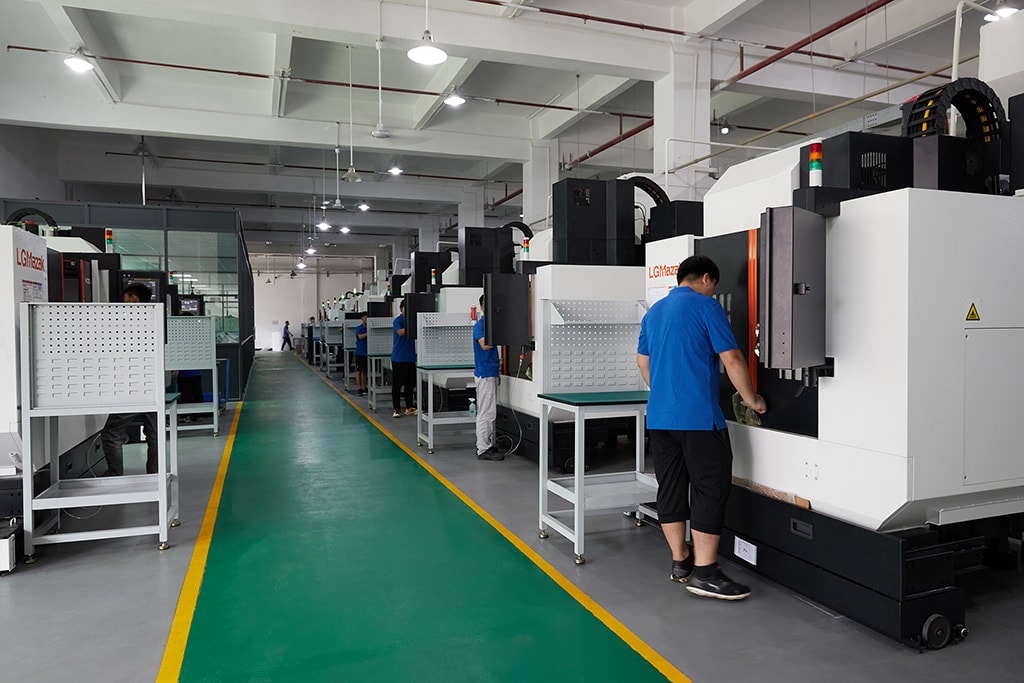
Capacity is the physical reason a date holds. With 100+ production machines and 100+ employees, work spreads across parallel machines instead of queueing behind a single bottleneck — a turned part, a prismatic part, and a long thin part can all run at once.
The difference: a shop with depth in each machine type absorbs several orders arriving together; a shop with one of each promises the date and hopes. When the date matters, ask about the machine mix, not just the promise.
Can a Service Start From One Prototype?

Yes — the minimum order quantity is 1 piece, which is a lead-time planning tool as much as a cost tool. A single prototype lets you validate function and the supplier's process before committing a production run, and the same reviewed geometry then scales into volume without a second tooling round.
The schedule benefit is real: a prototype that runs through the actual process steps gives you a measured baseline for the production date, instead of an estimate that has never been tested on your part.
The prototype also tests the routing, not just the part. A first article reveals whether the part really routes through mill-turn in one setup or whether it actually needs a hand-off to a mill, and that discovery, made at one piece, is what keeps the volume date honest. Made at volume, the same discovery would be a missed date and a price change.
How Do You Get an Honest Delivery Date?

Send four things to [email protected]: a STEP or IGES model, a 2D drawing with tolerances, the material grade, and your target quantity — plus any surface finishing or heat treatment. The response confirms the date against the part's actual process steps.
If your target will not hold, the response says so and explains why, rather than echoing the date back. That honesty is the entire value of lead-time planning: a date you can trust is worth more than a date that flatters you and slips.
How Do You Choose Between Turning, Milling, and Mill-Turn?
The choice is made by the geometry, not by preference. A part that is mostly round — shafts, pins, bushings — belongs on a lathe. A part that is mostly flat or boxy — housings, brackets — belongs on a mill. A part that has both turned and milled features, and needs them to share a datum, belongs on a mill-turn center, where the part is clamped once and finished.
The schedule consequence is direct: a part that moves between a lathe and a mill picks up a hand-off and a queue between the two, while the same part on a mill-turn center skips that hand-off entirely. Fewer hand-offs means less handling time, which means a shorter and more predictable schedule. The process choice is a schedule choice wearing a routing label.
When Does Precision Grinding Become Necessary?
Grinding enters the routing when a surface needs roundness, finish, or size that cutting alone cannot hold — a bearing seat, a seal surface, a diameter that must hold ±0.002 mm instead of ±0.003 mm (milling) / ±0.002 mm (turning). Grinding is a separate process with its own cycle and its own inspection, so it adds a stage to the schedule rather than replacing a cut.
The honest planning point is that grinding is not an upgrade, it is a different operation with a different cost and time. A part that genuinely needs it pays for it; a part that does not should not be routed through it. The supplier who reads the drawing and routes only the surfaces that need grinding is protecting both your schedule and your price.
How Do You Judge Whether a Service's Schedule Is Honest?
The same test that applies to a part applies to a service: ask for the steps, and watch whether the answer has arithmetic behind it. A service that quotes one date for turning, milling, mill-turn, and grinding alike has not read the drawing, because those four processes do not run on the same clock.
- Ask which process your part routes through. The routing determines the steps, and the steps determine the date.
- Ask whether the routing is in-house. A cut that leaves the building adds a hand-off and a queue you do not control.
- Ask whether finishing is included. Plating and heat treatment are a stage, not a footnote.
- Ask what holds the date. 100+ machines and 100+ employees is a physical answer; "we'll try" is not.
How Does the Process Table Help You Pick a Service?
The table in the section above maps each process to what it is for and what tolerance it holds. Read it as a routing guide: your part's shape picks the process, and the process picks the schedule.
| Your part looks like | Route it through | Why |
|---|---|---|
| Round — shafts, pins, bushings | CNC turning | One clamp, round features, ±0.002 mm |
| Long and thin, small diameter | Swiss-type turning | Support close to the cut, no deflection |
| Prismatic — housings, brackets | CNC milling, 3/4/5-axis | Flat and pocketed features, ±0.003 mm (milling) / ±0.002 mm (turning) |
| Turned and milled, shared datum | Mill-turn | Single setup, fewer hand-offs |
| Bearing seat, roundness-critical | Precision grinding | ±0.002 mm finish and size |
The point of the table is not to make you a process engineer — it is to let you check whether the routing you were quoted matches the part you sent. A mismatch between shape and routing is the first sign the drawing was not read carefully.
What Does "Scoped Into the Same Order" Mean for Finishing?
When heat treatment or surface finishing runs through a qualified partner, the honest shop scopes it into the same order instead of handing it off silently. The phrase matters because it means the finishing stage is on the schedule from the start, with a name and a cycle time, rather than appearing mid-run as a surprise.
Ask what "scoped into the order" covers: which finishing, who performs it, and whether its cycle time is already inside the quoted date. If those three questions are answered plainly, the finishing is planned. If they are not, the finishing is a risk the schedule has not priced in yet.
How Do You Pick a Machining Service You Can Plan Around?
The selection is not about the process list — every shop lists the same processes. It is about whether the schedule behind the list is honest, and the checks below cut to that.
- Ask for the routing, not just the capability. "We offer turning and milling" is a list; "your part routes through mill-turn, single setup" is a plan.
- Ask where each stage happens. In-house cuts hold the schedule; subcontracted cuts hold their breath.
- Ask about finishing up front. Name it first, or pay for the surprise later.
- Ask for one prototype. MOQ 1 runs the actual routing and gives you a measured date for volume.
- Ask for the honest no. A service that will tell you a target will not hold is the one you can plan around.
How Do You Compare Two Service Quotes Fairly?
Two quotes for the same part can differ in price and date for one reason only: they are counting different steps. To compare them fairly, line up the routing, not the bottom line. One quote may assume mill-turn in a single setup; another may assume separate turning and milling with a hand-off between them. Both describe the same part, but only one describes the schedule you will actually experience.
Ask each supplier to name the routing and the stages. A quote that names more steps and a longer date may be the honest one; a quote that names fewer steps and a shorter date may be leaving work out of the estimate. Comparing routings is how you find out which is which — before the shorter date has already slipped.
How Does the Schedule Change When a Part Needs Several Processes?
A part that needs turning and then milling crosses a hand-off between two machines, and that hand-off is real time on the schedule. It is not just the cycle time of two operations added together; it is the queue and handling between them. A mill-turn center removes that hand-off by doing both in one clamp, and the schedule shortens for that reason alone.
This is why "which processes does my part need" is a schedule question, not a menu question. Every process boundary the part crosses adds a hand-off, and every hand-off adds queue time. The parts with the longest schedules are rarely the ones with the longest cuts — they are the ones that cross the most boundaries.
Why Does the First Reply Tell You Whether the Schedule Is Real?
Watch the first reply, because it reveals the order of operations in the supplier's head. A serious shop asks for the model, the drawing, the material, and the quantity before it says anything about a date. A shop that answers the date in the first line, before the file has even arrived, has inverted the sequence — the answer came before the read, which is the definition of a guess.
What this shop actually runs
Ask for capability evidence and the answer should be specific. The facility behind this guide runs 100+ CNC machines on a 6,800 m2 floor in Dongguan, China, with 100+ staff. The machine list, by category:
- 5-axis machining centres (10+) - Mazak VARIAXIS I-600 (510/910/510 mm travel, 12,000 rpm, 22 kW, 71.6 N·m, 30-tool BT40) and Mazak INTEGREX I-250H S (B-axis 0.0001°, 24 kW, 124 N·m, 38-tool HSK-A63). Intended for compound-angle parts, single-setup multi-face prismatic work, and aerospace fittings where datum transfer loss is unacceptable.
- 3-axis / 4-axis machining centres (50+) - Brother SPEEDIO S500Z2N / S700Z2N (10,000 rpm, 14/21-tool ATC, 0.7 s tool-to-tool, Z-axis 2.2 G) and Mazak VCE-430A L / VCE-570C L (10,000 rpm, 118 N·m, 24-tool ATC). Intended for prismatic parts, plates, brackets, housings.
- Swiss-type turning centres (10+) - Citizen Cincom A20-3F7 (Φ20 mm, 10,000 rpm), TSUGAMI B0206-III / B0205-III (Φ20 mm, 0.1 µm), STAR SR-32JII / SR-32J Type N (Φ32 mm, 8,000 rpm). Intended for long, slender rotational parts at ±0.002 mm.
- CNC turning centres (20+) - HEADMAN T70M/1250 (720 mm swing, 117 mm bore, 3,000 rpm, BMT75 12-station turret). Intended for shafts, bushings, flanges up to ±0.002 mm.
- Wire EDM (5+) - Sodick AQ535L (550/350/300 mm travel, ±20° taper, 800 kg workpiece). Intended for hardened tool steel, internal splines, sharp internal corners that milling cannot reach.
- Inspection: Hexagon CMM + 20+ gauges - Hexagon CMM for coordinate measurement, plus vision system, profilometer, hardness tester, coating thickness gauge, XRF for material verification. The 10:1 rule (gauge 10x more accurate than the band) is applied to every feature.
- Machine highlights - VARIAXIS I-600: one-setup multi-face 5-axis + MAZA-CHECK auto-calibration; INTEGREX I-250H S: DONE-IN-ONE mill-turn, B-axis 0.0001° + Ai thermal shield; SPEEDIO S500Z2N / S700Z2N: Z-axis 2.2 G + 0.7 s ATC; Swiss-type: guide-bush switchable + 0.1 µm resolution.
Tolerances held: milling ±0.003 mm, turning ±0.002 mm, grinding and wire EDM ±0.002 mm. Capability: Ppk >= 1.67 initial and Cpk >= 1.33 in production on key characteristics.
Certifications: ISO 9001:2015 (116024/A/0001/UK/En), IATF 16949:2016 (131941/A/0001/SM/En, clause 8.3 design excluded, disclosed openly) and ISO 14001:2015 (116024/B/0001/UK/En), issued to Dongguan Zhuohang Ltd, USCC 91441900MA4UWT6X39, established 2005.
Service area: Austria, Belgium, the Czech Republic, Denmark, France, Germany, Greece, Hungary, Ireland, Italy, the Netherlands, Spain, Sweden and the United Kingdom in Europe; Brazil, Canada, Mexico and the United States in the Americas; China, Israel, Japan, Singapore and Sri Lanka in Asia; Australia and New Zealand in Oceania; and South Africa in Africa — built in China, shipped worldwide.
Contact: Felipe Iglesias, [email protected], +86 13126536955.
Get a service schedule that was read, not guessed
Email [email protected] or call +86 13126536955 — the date is confirmed against the drawing.
Frequently Asked Questions
How are these machining services scheduled?
By reading each part's process-step count, not by a blanket date. Simple parts ship in roughly 3 days, standard parts in about 7, and complex parts that run 10–20 steps or include finishing take around 30 days. The drawing sets the date.
Which machining processes are offered?
CNC turning (standard, Swiss-type, and mill-turn), CNC milling in 3, 4, and 5 axes, mill-turn machining, and precision grinding, all in-house. Heat treatment and surface finishing run through qualified partners and are scoped into the same order.
Why does finishing push a part into the long tier?
In short, Because anodizing, plating, powder coating, and heat treatment add a separate stage after machining with its own cycle time. That extra stage is real time the schedule must account for, which is why finishing is named up front rather than discovered later.
How does capacity hold the committed date?
In short, With a floor of 100-plus machines and 100+ employees, work spreads across parallel machines instead of queueing behind a bottleneck. A turned part, a prismatic part, and a long thin part can all run simultaneously, which is what keeps a committed date real.
Can a service start from one prototype?
Yes. The minimum order quantity is 1 piece, so a prototype can be scheduled and validated before volume is committed. The same reviewed geometry then scales into a production run without a second tooling round.
How do I get an honest delivery date?
Send a STEP or IGES model, a 2D drawing, the material grade, and your target quantity to [email protected]. The date is confirmed against the part's actual process steps, or the supplier says honestly that your target will not hold.
How do you choose between turning, milling, and mill-turn?
By geometry. Round parts go to a lathe, prismatic parts to a mill, and parts with both turned and milled features that share a datum go to mill-turn in a single setup. Fewer hand-offs means a shorter, more predictable schedule.
When does precision grinding become necessary?
In short, When a surface needs roundness, finish, or size that cutting cannot hold — such as a bearing seat that must hold ±0.002 mm instead of ±0.003 mm (milling) / ±0.002 mm (turning). Grinding is a separate stage with its own cycle, so it only belongs on the surfaces that need it.
How do you judge whether a service's schedule is honest?
Ask for the routing and the steps behind the date. Four processes — turning, milling, mill-turn, and grinding — do not run on the same clock, so one date for all of them means the drawing was not read.
What does "scoped into the same order" mean for finishing?
In short, It means the finishing stage is on the schedule from the start, with a name and a cycle time. Ask which finishing, who performs it, and whether its time is already inside the quoted date — the answers tell you whether the finishing is planned or a surprise.
How do you compare two service quotes fairly?
Line up the routings, not the bottom lines. A quote that assumes mill-turn in one setup describes a different schedule from one that assumes separate turning and milling. Name the stages, and the honest quote is the one that leaves nothing out.
How does the schedule change when a part needs several processes?
Every process boundary the part crosses adds a hand-off and a queue. A part that needs turning and then milling picks up time between the two; a mill-turn center removes that hand-off by doing both in one clamp.
Why does the first reply tell you whether the schedule is real?
In short, Because the order of the reply reveals the order of the thinking. A shop that asks for the model, drawing, material, and quantity before naming a date is reading the part; a shop that names the date first has answered before it read, which is a guess.
Continue reading: Custom Machining Factory · Custom Machining Services · Custom Machining Parts Manufacturer
Standards referenced on this page
- ASTM A582/A582M-12 — Standard Specification for Free-Machining Stainless Steel Bars
- ISO 9001 — Quality management systems — Requirements
- ASTM E8/E8M-21 — Standard Test Methods for Tension Testing of Metallic Materials