
- Sourcing CNC machining? The test is not the tolerance printed on a brochure — it is whether the shop can hand you a CMM report for the exact feature you are buying, with the band, the sample size and the study window all named.
- What CNC machining is: a subtractive process — a cutter removes material from a workpiece along a programmed toolpath until the geometry, tolerance and surface finish on the drawing exist.
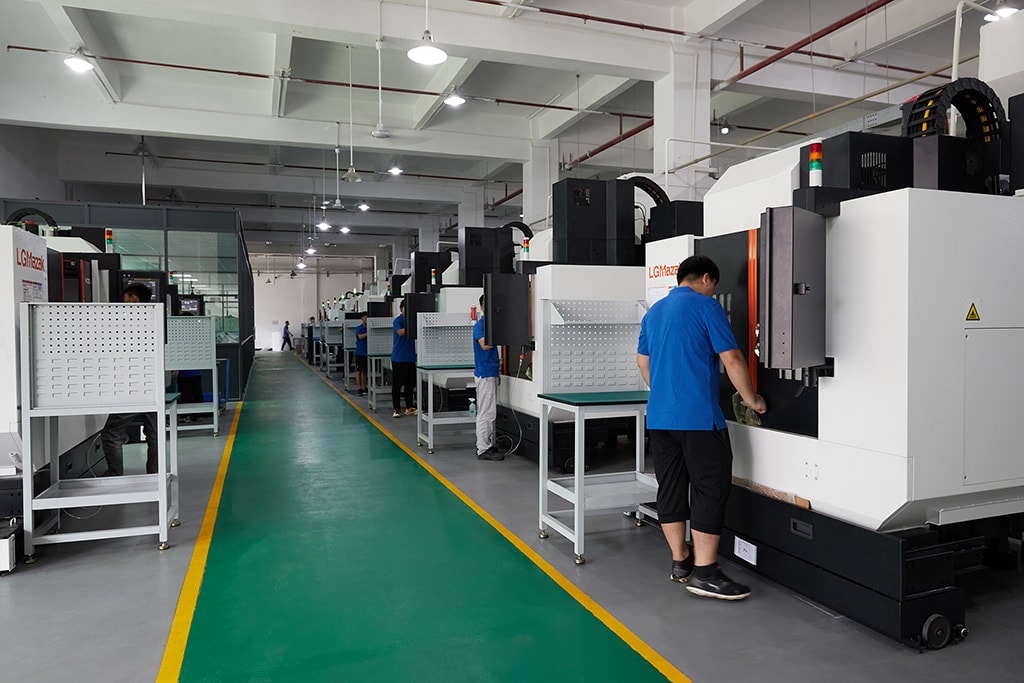
- 100+ production machines — Mazak / Brother / Tsugami / Star / Citizen class, across a 6,800 m² facility (3-axis 50+, 4-axis 20+, 5-axis 20+, 25+ lathes, 7+ grinders, 20+ inspection instruments).
- Measured, not claimed: ±0.003 mm, turning ±0.002 mm, grinding ±0.002 mm, verified on Hexagon CMMs. Per-characteristic capability is Ppk ≥ 1.67 initial and Cpk ≥ 1.33 production (≥ 1.33 general). Reports name the feature, band, sample size, sigma method and window.
- Three certificates — ISO 9001:2015, IATF 16949:2016 (design excluded) and ISO 14001:2015, all held by Dongguan Zhuohang Ltd, the entity that invoices you.
- Order terms: a one-piece minimum and lead times around 3, 7 or 30 days, set by part complexity.
What is custom machining?
Custom machining is machining done to your drawing and your specification, not to a catalog — geometry, material, tolerance and finish are all yours to set. The Dongguan plant behind this page quotes each job on its own process route and holds ±0.003 mm milling and ±0.002 mm turning. Because nothing is standardized, lead time is set by capacity and complexity rather than by promise.
CNC machining is the subtractive manufacturing of parts on computer-numerically-controlled milling, turning, and grinding equipment. A cutter removes material from a workpiece along a programmed toolpath to produce a part that meets a drawing-defined geometry, tolerance, and surface finish. "CNC" means the tool path is numerically controlled rather than hand-operated.
The rest of this guide turns that definition into a buyer's checklist for this shop — what to verify before you commit, and how the numbers on the drawing actually reach the part.
The discipline separates into milling (the cutter rotates and the workpiece is fed; prismatic geometry), turning (the workpiece rotates and the tool is fed; rotational geometry), and precision grinding / wire EDM (the tightest tolerances on critical features). A plant that produces CNC machined parts end-to-end runs all three.
The output of CNC machining is a part that meets the drawing — geometry, tolerance, surface finish, and material certificate — and is documented to a quality plan (FAI for general work, PPAP for automotive-bound parts, IMDS for material data). That is the answer to "what is CNC machining": a numerically-controlled subtractive process that produces a part to a drawing, with the quality documentation that lets the part enter an assembly.
- 3 / 7 / 30-day lead times — set by part complexity and process steps, not by optimism.
- 100+ production machines and 100+ employees in a 6,800 m² facility.
- 10–20 process steps — the range a complex part can run, each adding time.
- MOQ 1 piece — a prototype can be scheduled before volume is committed.
How Is a Machining Lead Time Actually Set?
The short answer: by reading the part, not by reciting a number. A lead time is the sum of the process steps a part needs — the operations, the setups, the inspection, the finishing — and each step takes time that a simpler part never spends. The honest structure is three tiers: roughly 3 days for simple parts, 7 days for standard work, and 30 days for complex parts.
The distinction matters because a supplier who quotes a date before seeing the drawing is guessing. The part's complexity is the schedule, and complexity is only visible on the drawing. That is why the date is confirmed against the actual file, and why a target date that survives that read is a date you can build your own production plan on.
How do you judge whether the tier you were given is honest? Compare the date to the part, not to your wishes. A simple turned pin belongs in the short tier; a housing with tapped holes, tight bores, and a plating call-out does not. If a supplier places a complex part in the short tier, ask which steps they left out, because the steps are still there whether they are named or not.
Why Do Complex Parts Take Longer?
Because time in machining is driven by the number of hand-offs, not by any single operation. A complex part can run 10–20 process steps, and every step — each setup, each operation, each inspection, each finishing stage — adds queue and handling time. A simple part with three operations is in and out; a complex part accumulates a schedule across every stage it passes through.
Surface finishing and heat treatment compound this: they add a whole additional stage after the metal is cut, and that stage has its own cycle time. A part that needs anodizing or plating therefore lands in the longer tier almost by definition. The honest planning move is to name the finishing up front, so the schedule accounts for it rather than being surprised by it.
It helps to separate cycle time from queue time. Cycle time is the minutes a tool spends cutting; queue time is the hours a part spends waiting between steps. Both are real, but they behave differently: cycle time is set by the geometry and material, while queue time is set by how many other jobs are in the building. A supplier who only quotes cycle time is telling you half the schedule, and the half they are leaving out is usually the half that slips.
How Does Capacity Determine Whether a Schedule Holds?

Lead time is the promise; capacity is what makes the promise true. A schedule only holds if there are enough machines and people to absorb the work when it arrives, rather than queueing it behind a bottleneck. Capacity here is 100+ production machines and 100+ employees across a 6,800 m² facility.
The practical effect is that work can be spread: a turning part goes to a lathe, a prismatic part to a mill, a long thin part to a Swiss machine — in parallel, not in one queue. That parallelism is what turns a three-tier lead time from an estimate into a commitment. A shop with one machine of each type promises dates; a shop with depth in each type can hold them.
Capacity is also the part of the date you can verify before placing an order. Ask what sits behind the number: how many machines, which types, how many people, how much floor. A supplier who can name the machines by brand and role is describing a floor they actually have. A supplier who answers "we have enough" is describing a hope, and a hope is not the same thing as more than 100 machines in a 6,800 m² building.
Can a Schedule Be Guaranteed Before the Drawing Is Read?
No, not honestly. A date is only real once the drawing has been read against the process steps it actually requires, and any supplier who promises one before seeing the file is answering a question that has not been asked yet. The honest sequence is: read the drawing, count the steps, check the capacity, then commit the date.
This is the difference between a schedule and a guess, and it protects the buyer more than it protects the supplier. A date that survives an honest read of the part is one you can plan your own assembly, your own inventory, and your own customer commitments around. A date that is just echoed back is a risk you are being asked to absorb silently.
Watch what happens when you ask a supplier to read the drawing before quoting. A serious shop will ask for the file first and treat your date question as downstream of the read. A shop that answers the date instantly, before the file has even arrived, has just skipped the only step that makes a date real. The refusal to wait for the drawing is not speed — it is the tell that the answer is not connected to the part.
How Does Process-Step Count Turn Into a Delivery Date?
The relationship is direct, even if it is not a formula: more steps means more time, and the steps that push a part into the long tier are the ones that involve secondary operations. The table below is the planning logic, not a price list.
| Part profile | Process steps | Approx. lead time |
|---|---|---|
| Simple — few operations, one material, no finishing | Minimal | ~3 days |
| Standard — multiple operations, standard tolerances | Several | ~7 days |
| Complex — many steps, or surface finishing / heat treatment | 10–20 steps | ~30 days |
The rule is qualitative, not a formula: the more operations a part needs, and the more secondary stages it crosses, the longer the schedule. A supplier who states this plainly is giving you the information you need to plan; one who hides it is hiding the risk.
Read the table above as a way to sanity-check any date you are handed. If your part has tapped holes, tight bores, and a plating call-out, and the quoted date matches the simple tier, the schedule has almost certainly dropped a step somewhere. The honest response to that mismatch is not to accept the flattering date — it is to ask the supplier which step they removed, and why the step will not come back later as a surprise.
How Does Quality Fit Into the Schedule Without Delaying It?
Quality and speed are usually framed as a trade-off, but in a well-planned shop they reinforce each other. In-process SPC and in-house CMM inspection catch a drifting dimension mid-run, when it is still cheap to correct, which prevents the one thing that destroys a schedule worse than any bottleneck: a full remake of a bad lot at the end of the run.
The traceability system records every lot to its material, machine, and operator, so when a non-conformance appears it is contained and corrected rather than re-litigated. That is, quality control here is not a gate that delays shipping — it is the mechanism that keeps the schedule from collapsing into rework.
For you, this reframes the quality question entirely. The right question is not "do you inspect" — every supplier claims they inspect. The right question is "where do you catch a drifting dimension, and what does it cost you when you miss it." A supplier who catches drift in-process is protecting your date. A supplier who only finds it at final inspection is protecting nothing but their paperwork.
How Do You Get an Honest Delivery Date?

The process is the same as the quote, because the date and the price come from the same read of the drawing. Send a STEP or IGES model, a 2D drawing with tolerances, the material grade, and your target quantity to [email protected], and name any surface finishing or heat treatment.
The response confirms the date against the part's actual process steps, or tells you honestly that your target will not hold, and why. That honesty is the entire point of lead-time planning: a date you can trust is worth more than a date that flatters you and slips.
A good response looks a specific way: it names the tier, lists the steps that set it, flags any finishing or heat treatment, and states the capacity that holds it. If the date will not meet your target, it says so plainly and offers the nearest honest alternative. A response that is only a date — with no steps, no tier, no caveat — is the same guess you could have written yourself, and it deserves the same weight.
Why Would a Supplier Guess a Date Instead of Reading the Part?
A guess is cheap to produce and easy to say; a specific "no" is hard to deliver. Reading a drawing takes real work — tolerances checked against the machines, finishing named, the queue and capacity looked at honestly. A supplier who skips that work answers in seconds, and the flattering date wins the order. The cost of the shortcut does not land on the supplier. It lands on your assembly line, your inventory, and your own customer commitments when the date slips.
The counter is simple: ask for the step count behind the date. A date that came from a real read can be walked through — this operation, this many setups, this finishing stage, this inspection pass. A guess cannot survive that walk, because there is no arithmetic to show. When a supplier cannot show the steps, they have just told you the date was a wish, and you did not have to accuse anyone of anything.
Notice what this means for your leverage. You do not need to be a machinist to run the test. You need to ask the supplier to show their reasoning, and then watch whether the reasoning exists. If it does, the date is probably real. If it does not, the date was probably invented to make you say yes.
What Is the Real Difference Between a Lead Time and a Promise?
A lead time is the output of a calculation. A promise is the output of optimism. The calculation has inputs — process steps, setups, inspection, finishing — and a capacity check on top of them. Optimism has no inputs at all, which is why it can be produced instantly and why it collapses the moment it meets the actual part.
You can tell the two apart with one question: "walk me through which steps produce which days." A lead time survives the walk because every day is attached to a step. A promise evaporates because no step backs it up. The date that survives the walk is the only date worth writing into your own production plan; everything else is a hope with a calendar attached.
The same part, quoted by two suppliers, illustrates the point. The supplier who names more steps and a longer date may be the honest one, not the slow one. The supplier who names fewer steps and a shorter date may be selling optimism. Between the two, the longer date is often the one that actually happens, and the shorter one is the one that slips twice.
How Do You Test Whether a Date Is Real Before You Commit?
The test does not require trusting anyone. It requires asking the supplier to show the reasoning instead of the answer. Four questions do the job, and the direction of the answer is visible before any money moves.
| You ask | A guessed date does | A read date does |
|---|---|---|
| Which process steps set this date? | Restates the date, names no steps | Lists the operations and setups |
| Is finishing or heat treatment included? | Discovers it after the fact | Names it up front, in the 30-day tier |
| What if my target will not hold? | Echoes the target back | Says so, and explains why |
| Can I validate one prototype first? | Pushes straight to volume | Runs MOQ 1, then scales |
Each row is a fork in the road. A supplier who lands on the right side of every row is giving you a schedule you can build on. A supplier who lands on the left has already told you the date is a guess — you just have not admitted it to yourself yet.
Which Questions Separate a Real Schedule From a Flattering One?
These five questions can be run in a single email, and each one forces the supplier to reveal whether a date was read or guessed.
- Ask for the step count. A real schedule is built from operations; ask which ones, and how many, before you accept the date.
- Ask about finishing up front. Anodizing, plating, powder coating, and heat treatment add a stage after the metal is cut — ask whether the date already includes it.
- Ask what sits behind the date. a floor of 100-plus machines and 100+ employees across 6,800 m² is the physical reason a date holds; a date with no capacity behind it is just a number.
- Ask for the honest no. A supplier who will tell you a target will not hold is protecting your plan; one who echoes everything back is protecting their own.
- Ask for one prototype first. MOQ 1 lets you measure the real process on your own part before you commit volume to a schedule.
Why Three Tiers Instead of a Single Number?
A single number for every part is the signature of a guess, because one date cannot describe a part with three steps and a part with 10–20 steps at the same time. The three tiers — roughly 3 days for simple parts, 7 days for standard work, and 30 days for complex parts — exist because the schedule is a function of the part, not a fixed output of the shop.
Read the tiers as a map, not a menu. A supplier who places your part in a tier is telling you how much work the drawing contains. A supplier who ignores the tiers and hands you one date for everything is telling you they have not looked at the drawing at all — the same way a flat price for every part would tell you the cost has not been read either.
What Happens When the Drawing Changes After the Date Is Set?
An honest supplier re-reads the part instead of holding the old date. A revision can add or remove steps — a new tapped hole, a tighter tolerance, a finishing requirement that was not there before — and the schedule follows the steps, not the original promise. The discipline is exactly the same as the first read: the drawing sets the date, so a changed drawing resets it.
This is where the difference between a lead time and a promise shows up a second time. A supplier who ignores the revision and holds the date is guessing again, because the date no longer describes the part being made. A supplier who re-reads the revision and tells you what changed — and by how much — is the one keeping your schedule honest. That honesty is inconvenient for a moment and invaluable for the whole program.
How Does Material Choice Change the Lead Time?
Material sets the speed of the cut, and the speed of the cut is repeated on every process step. A free-cutting aluminum machines fast; a tough stainless or a titanium alloy cuts slower and wears tooling faster, so the same geometry takes longer to reach its last operation. The material line on the drawing is therefore a schedule input, not just a chemistry note.
The comparison below is a planning guide, not a capability limit — the shop machines all of these. The point is that a date quoted without reading the material call-out is a date for a part that may not exist.
| Material family | Common grades | Machinability | Schedule effect |
|---|---|---|---|
| Aluminum | 6061-T6, 7075-T6, 5052 | High — fast cuts, long tool life | Shortest cycle time; short/middle tier |
| Brass | — | High — free-cutting | Short tier |
| Carbon / alloy steel | 4140 | Moderate | Middle tier |
| Stainless steel | 304, 316 | Lower — work-hardens, wears tools | Middle/long tier |
| Titanium | — | Low — slow cuts, heavy tool wear | Long tier |
Material also affects the schedule through availability. A stock grade in a common size is pulled from the rack; a rare alloy in an unusual size waits for procurement, and procurement is a stage before the first cut. The honest supplier names both the machinability and the availability when they read the drawing, because both are time.
How do you check this in a quote? Ask whether the material grade was read before the date was set. A supplier who quotes the same date for an aluminum bracket and a titanium one has skipped the material line on the drawing — the same way a supplier who quotes one date for every part has skipped the drawing entirely.
What Does Surface Finishing Add to the Schedule, Exactly?
Finishing is a stage, not a step. After the metal is cut, the part moves to a second operation — anodizing, plating, powder coating, or heat treatment — each with its own cycle time that stacks on top of the machining. This is the mechanical reason a finished part lands in the 30-day tier while an as-machined part may ship in days.
Surface finish has a language of its own, and it is worth reading before you quote. Ra is the arithmetic average roughness, the most common call-out on a drawing.
| Ra value | What it means | How it is produced | Schedule effect |
|---|---|---|---|
| Ra 3.2 µm | Standard as-machined finish | Normal milling / turning pass | No extra stage |
| Ra 1.6 µm | Fine machined finish | Slower feeds, finishing pass | Adds machine time |
| Ra 0.8 µm | Smooth finish | Fine pass or light grinding | Adds a stage |
| Ra 0.4 µm | Polished / ground | Grinding or polishing | Separate operation |
Each step down the Ra ladder is a step up in time, because a finer finish needs a slower pass or a separate operation. Your discipline is the same as with tolerance: call out the finish the function needs, not the finish that looks precise. A decorative surface called out to Ra 0.8 µm is a schedule tax with no functional return.
The honest planning move is to name the finishing in the first message. When the finishing appears in the review, the schedule has a place for it; when it surfaces after the date is quoted, the date never included it, and the tier you were told is one stage shorter than the part you will receive.
Which Tolerance Call-Outs Add Time to the Schedule?
A tolerance is a schedule input wearing a drawing label. Holding a dimension tight means slower feeds, a finishing pass, more careful measurement, or a move to grinding — all of which are time. The looser the call-out, the faster the part clears each operation.
General tolerances are usually referenced to a standard such as ISO 2768, which defines three grades.
| Grade | Meaning | Typical use | Schedule effect |
|---|---|---|---|
| ISO 2768-m | Medium | General machined features | Standard feeds |
| ISO 2768-f | Fine | Fits and locating features | Slower feeds, more inspection |
| ISO 2768-c | Coarse | Non-critical dimensions | Fastest clearing |
Above the general tolerances sit the specific ones — a bore that locates a bearing, a diameter that seals — and those are the ones that cost time. Turning and milling hold ±0.003 mm (milling) / ±0.002 mm (turning), and precision grinding holds ±0.002 mm; the difference between the two is a separate process with its own cycle and inspection.
your question is "which tolerances are functional?" A functional tolerance is worth its time; a habit tolerance — a pocket called out as tight as a bearing seat — costs time and money for no return. An honest supplier flags that in the review instead of silently charging for it.
How Do Design Decisions Remove Steps From the Schedule?
The cheapest place to shorten a schedule is in the design, before a single chip is cut. Every step a part needs is time and money; remove a step in the model and both fall at once, without touching function. The rules below are the standard geometry checks, and each one is a step that can be avoided.
- Avoid deep, narrow pockets. A pocket deeper than the tool can reach needs a longer tool, a slower feed, or an extra setup. Shallow, open pockets clear fast.
- Keep wall thickness above a practical minimum. A wall that is too thin flexes under the cutter, so it needs lighter cuts and more passes. A stiffer wall machines in fewer passes.
- Match internal radii to standard tools. A sharp internal corner needs a small tool and a slow feed, or a second operation. A radius that matches a standard end mill clears in one pass.
- Avoid undercuts. A feature the cutter cannot reach from above needs a second setup or an EDM stage. Redesign the feature to be reachable, and the stage disappears.
- Standardize hole sizes. Every distinct diameter is a tool change and a setup. Fewer diameters means fewer changes, which means fewer steps.
None of this asks you to be a machinist — it asks you to send a drawing that has already been looked at with a schedule in mind. The buyer who runs these checks before quoting removes the steps on the screen, where they are free, instead of on the machine, where they are not.
The honest supplier points these out in the review. A supplier who says nothing and quotes the long tier is charging you for steps the design never had to carry; a supplier who flags them is treating your schedule as shared property, not as a number to be padded.
How Does a Prototype Shorten the Volume Lead Time?
A prototype is a schedule tool as much as a function test. At MOQ 1, a single part runs through the actual process steps and produces a measured baseline — the real cycle time, the real setup count, the real hand-offs. That baseline is what the volume date is then built on, instead of an estimate that has never touched your part.
The sequence matters, and it is the same sequence for every honest program.
| Stage | What it does | What it buys the schedule |
|---|---|---|
| First article (MOQ 1) | Runs the real routing once | Measured cycle time and setup count |
| Validation | Confirms function and tolerance | Locks the geometry before volume |
| Volume ramp | Same geometry, batched steps | A date built on measured time, not a guess |
The prototype also settles the price argument before it starts. A first article that runs through the actual process produces numbers both sides can read, which become the numbers behind the volume quote. Without it, buyer and supplier are negotiating over an estimate, and an estimate is the raw material a dishonest schedule is made of.
This is why "one prototype first" appears in your questions on this page. It is not a nicety; it is the cheapest way to convert a guessed date into a read one, at a cost of one part instead of a full run.
How Does the Schedule Change When Quantity Grows From One to Many?
Quantity does not compress the process steps — a complex part still runs 10–20 steps whether the order is one piece or a thousand. What changes is how the steps are arranged. Setup and programming are paid once and then spread across the run, so per-piece cost falls while the per-part steps stay the same.
The schedule question therefore is not "how fast is one part" but "can the capacity absorb the whole run without queueing behind other jobs." A run of several hundred parts needs machine depth and floor space, not just speed — the same parallel capacity that holds a single date holds a full order when it arrives with others.
The honest supplier answers the volume question the same way it answers the single-part question: by reading the drawing and checking the capacity, not by scaling the date blindly. A date that is a straight multiple of the single-part time is usually wrong in one direction or the other, because batching and queueing do not scale linearly.
Ask how the run will be scheduled, not just how long one part takes. The answer tells you whether the supplier has thought about your order as a whole, or whether they are quoting you one part and hoping the rest of the run fits around it.
What Happens When Several Orders Arrive at Once?
This is the moment a schedule is actually tested. A shop that promises a date in quiet times and slips in busy ones is a shop whose capacity was never the real plan. The honest schedule holds in the busy week, not just the empty one, and the reason is parallelism: work is spread across machines, not stacked behind one bottleneck.
Queue time — the hours a part waits between steps — is set by how many other jobs are in the building. Cycle time — the minutes a tool spends cutting — is set by the geometry. A shop with depth absorbs several orders by running them side by side; a shop with one of each machine serializes them, and the queue time swallows the promise.
This is why "how many machines" is a schedule question, not a trivia question. a floor of 100-plus machines and 100+ employees across a 6,800 m² floor mean a new order is absorbed into parallel capacity. A shop that cannot answer the question — or answers it vaguely — is asking you to trust a date that has no floor under it.
The test for you is to ask how the shop handles a full week, not a quiet one. The answer you want is specific: which machines run which parts, and how the queue is managed. The answer you should distrust is "we always find a way", because a way that is not named is a hope, and a hope is not a schedule.
How Do You Weigh a Long Honest Date Against a Short Guessed One?
Two suppliers quote the same part. One names more steps and a longer date; the other names fewer steps and a shorter date. The instinct is to take the short date. The honest read is often the opposite: the longer date is the one that was counted, and the shorter one is the one that will slip twice.
The reason is that the steps do not disappear when they are left out of the quote. A tapped hole, a tight bore, a plating call-out — they are in the drawing whether or not the supplier named them. The supplier who leaves them out is selling you a date for a part with fewer steps than the one you will receive, and the difference arrives later as a slip.
The weighing is therefore a step count, not a calendar comparison. Ask each supplier to walk the date: which operations, which setups, which finishing, which inspection. The date that survives the walk is the one that is real, and it is usually the longer one. The date that cannot be walked is optimism, and optimism is the most expensive thing in a supply chain.
This is the entire discipline of this page in one decision: a date you can trust is worth more than a date that flatters you. The flattering date costs you the order's deadline, the inventory, and the customer commitment it was meant to protect. The trusted date costs you only the honesty of hearing it.
How Does the Honest Date Travel From Drawing to Delivery?
The date is not produced in one act; it is produced by a chain of readings, and every link either holds or breaks it. Walk the chain once and you will know where a supplier's honesty actually lives.
| Link | What happens | What it decides |
|---|---|---|
| Read the drawing | Features, tolerances, material, finishing are counted | Which tier the part belongs in |
| Count the steps | Operations, setups, hand-offs are listed | The number behind the date |
| Check the capacity | Machines and people are matched to the work | Whether the date can hold |
| Commit the date | The tier, steps, and capacity are stated plainly | The date you can plan on |
| Hold the date | In-process control catches drift before it becomes a remake | Whether the date survives to shipping |
Each link is a place where the honest supplier says something specific and the guesser stays vague. The supplier who can describe all five links is describing a system; the supplier who can only describe the last one — the date itself — is describing an output with no process behind it, and an output with no process is a guess.
For you, the chain is a checklist in disguise. You do not have to be a machinist to run it; you only have to ask, at each link, "what did you read, and what did it tell you." A real answer exists at every link; a guess has nothing to say at the first four.
Which Standard References Back the Numbers on This Page?
The numbers on this page are not invented; they hang on references you can look up. Knowing the references is how you check a quote without trusting the person who wrote it.
- ISO 2768 defines general tolerance grades — fine, medium, and coarse — for dimensions without an individual call-out. When a drawing says "general tolerance per ISO 2768-m," the grade tells you how much the part is allowed to drift before it is out of tolerance.
- Ra (surface roughness) is defined by surface texture standards and is the arithmetic average of the profile's departure from the mean line. A drawing that calls out Ra 1.6 µm is specifying a finish, and that finish costs machine time or a separate operation.
- Material grades such as 6061-T6, 7075-T6, 5052, 304, 316, and 4140 are standardized alloy designations with published properties. The grade is what the XRF check confirms against the mill certificate, so the alloy on the drawing is the alloy on the machine.
- Cpk is a process-capability index, and the key-characteristic standard this shop holds is Ppk ≥ 1.67 initial; the recorded Cpk = 1.851 (one characteristic on one part, not a blanket capability claim) on a representative length characteristic clears that bar.
Read the tolerance band before you read the index. Cpk is a ratio of the tolerance band to the process spread, not an absolute measure of accuracy. The figure above was recorded on a length characteristic with a 0.4 mm band (76.1–76.5 mm) — wide by design. Hold the same process spread against a ±0.005 mm feature and it fails outright. Ask for the band, the subgroup count and the sampling window on every capability number a supplier quotes.
The references matter because they turn a claim into something checkable. "Medium tolerance" is a claim; "ISO 2768-m" is a number you can look up. "Good finish" is a claim; "Ra 1.6 µm" is a measurement. A quote that names the references is a quote that can be verified; a quote that names only adjectives is a quote that cannot.
What this shop actually runs
A buyer asking for capability evidence should get a specific answer. The facility behind this guide operates 100+ CNC machines across a 6,800 m2 plant in Dongguan, China, with 100+ staff. The machine list by category:
- 5-axis machining centres (10+) - Mazak VARIAXIS I-600 (510/910/510 mm travel, 12,000 rpm, 22 kW, 71.6 N·m, 30-tool BT40) and Mazak INTEGREX I-250H S (B-axis 0.0001°, 24 kW, 124 N·m, 38-tool HSK-A63). Intended for compound-angle parts, single-setup multi-face prismatic work, and aerospace fittings where datum transfer loss is unacceptable.
- 3-axis / 4-axis machining centres (50+) - Brother SPEEDIO S500Z2N / S700Z2N (10,000 rpm, 14/21-tool ATC, 0.7 s tool-to-tool, Z-axis 2.2 G) and Mazak VCE-430A L / VCE-570C L (10,000 rpm, 118 N·m, 24-tool ATC). Intended for prismatic parts, plates, brackets, housings.
- Swiss-type turning centres (10+) - Citizen Cincom A20-3F7 (Φ20 mm, 10,000 rpm), TSUGAMI B0206-III / B0205-III (Φ20 mm, 0.1 µm), STAR SR-32JII / SR-32J Type N (Φ32 mm, 8,000 rpm). Intended for long, slender rotational parts at ±0.002 mm.
- CNC turning centres (20+) - HEADMAN T70M/1250 (720 mm swing, 117 mm bore, 3,000 rpm, BMT75 12-station turret). Intended for shafts, bushings, flanges up to ±0.002 mm.
- Wire EDM (5+) - Sodick AQ535L (550/350/300 mm travel, ±20° taper, 800 kg workpiece). Intended for hardened tool steel, internal splines, sharp internal corners that milling cannot reach.
- Inspection: Hexagon CMM + 20+ gauges - Hexagon CMM for coordinate measurement, plus vision system, profilometer, hardness tester, coating thickness gauge, XRF for material verification. The 10:1 rule (gauge 10x more accurate than the band) is applied to every feature.
- Machine highlights - VARIAXIS I-600: one-setup multi-face 5-axis + MAZA-CHECK auto-calibration; INTEGREX I-250H S: DONE-IN-ONE mill-turn, B-axis 0.0001° + Ai thermal shield; SPEEDIO S500Z2N / S700Z2N: Z-axis 2.2 G + 0.7 s ATC; Swiss-type: guide-bush switchable + 0.1 µm resolution.
Tolerance bands held: ±0.003 mm on CNC milling, ±0.002 mm on CNC turning, ±0.002 mm on precision grinding and wire EDM. Capability indices: Ppk >= 1.67 initial on key characteristics; Cpk >= 1.33 ongoing in production.
Certifications: ISO 9001:2015 (116024/A/0001/UK/En), IATF 16949:2016 (131941/A/0001/SM/En, design clause 8.3 excluded - disclosed openly), ISO 14001:2015 (116024/B/0001/UK/En). Certificates are issued to Dongguan Zhuohang Ltd (USCC 91441900MA4UWT6X39, established 2005).
Service area: Austria, Belgium, the Czech Republic, Denmark, France, Germany, Greece, Hungary, Ireland, Italy, the Netherlands, Spain, Sweden and the United Kingdom in Europe; Brazil, Canada, Mexico and the United States in the Americas; China, Israel, Japan, Singapore and Sri Lanka in Asia; Australia and New Zealand in Oceania; and South Africa in Africa. Based in China, serving customers worldwide.
Contact: Felipe Iglesias, [email protected], +86 13126536955.
Get a delivery date that was read, not guessed
Email [email protected] or call +86 13126536955 — the date is confirmed against the drawing.
Guides
- Custom machining cost in 2026 — your cost model read from the same drawing as the date.
Frequently Asked Questions
How exactly is a machining lead time actually set?
In short, It is set by the part's complexity and the number of process steps, not by a blanket promise. Simple parts ship in roughly 3 days, standard parts in about 7 days, and complex parts that run 10–20 steps or include surface finishing take around 30 days.
Why exactly do complex parts take longer?
Because every process step adds queue and handling time, and surface finishing or heat treatment adds a whole additional stage. A complex part can run 10–20 steps, and each hand-off between operations is time that a simple part never spends.
How exactly does capacity determine whether a schedule holds?
In short, Capacity is the number of machines and people available to absorb work. With 100+ production machines and 100+ employees in a 6,800 m² facility, a schedule holds because work can be spread across machines instead of queueing behind a single bottleneck.
Is a schedule ever guaranteed before the drawing is read?
No, not honestly. A date is only real once the drawing is read against the process steps it requires. A supplier who promises a date before seeing the part is guessing; the honest answer is a date confirmed against the actual drawing.
Does surface finishing change the lead time?
Yes. Anodizing, plating, powder coating, and heat treatment add a separate stage after machining, so a part with finishing falls into the longer tier of roughly 30 days. Finishing is named up front so the schedule accounts for it.
What is the minimum order quantity?
The minimum order quantity is 1 piece, so a prototype can be scheduled and validated before committing to volume. The same reviewed geometry then scales into a production run without a second tooling round.
How do I get an honest delivery date?
Send a STEP or IGES model, a 2D drawing, the material grade, and your target quantity to [email protected]. The date is confirmed against the part's actual process steps, or the supplier says honestly that your target will not hold.
How exactly does material choice change the lead time?
In short, Material sets the speed of every cut. Aluminum machines fast and lands in the short or middle tier; stainless and titanium cut slower and wear tooling faster, so they push a part toward the long tier.
What surface finish does a standard part ship with?
A standard machined part ships with an as-machined finish around Ra 3.2 µm unless the drawing calls out finer. Finer finishes — Ra 1.6, 0.8, or 0.4 µm — need slower passes or a separate grinding or polishing stage, which is why they add time.
How does a tighter tolerance lengthen the schedule?
In short, Tight tolerances need slower feeds, a finishing pass, more measurement, or a move to grinding. General tolerances follow a standard such as ISO 2768; the specific call-outs above it are the ones that add time.
Does a prototype guarantee the production date?
In short, It does not guarantee it, but it removes the guess. A first article at MOQ 1 runs the real routing and produces a measured cycle time and setup count, which become the baseline for the volume date.
What is the difference between queue time and cycle time?
In short, Cycle time is the minutes a tool spends cutting; queue time is the hours a part spends waiting between steps. Cycle time is set by geometry and material; queue time is set by how many other jobs are in the building.
How does the schedule change when quantity grows?
In short, The process steps do not compress — a complex part still runs 10–20 steps whether the order is one piece or a thousand. What changes is batching: setup is paid once and spread across the run.
Which standard references should I check in a quote?
In short, ISO 2768 for general tolerances, the Ra value for surface finish, and the material grade for the alloy. A quote that names these is checkable; a quote that names only adjectives — "medium tolerance," "good finish" — is not.
Do you use MIL-STD-105E or ANSI/ASQ Z1.4 sampling inspection?
In short, MIL-STD-105E is the U.S. military sampling inspection standard published in 1989; it specifies acceptable quality limit (AQL) sampling plans for lot-by-lot inspection.
Why exactly would a supplier guess a date instead of reading the part?
Because a guess is fast and flattering, and reading the drawing is work that produces hard answers. Your counter is to ask for the step count behind the date — a read date can be walked through, and a guess cannot.
What exactly happens when the drawing changes after the date is set?
The schedule follows the part, not the original promise. A revision that adds or removes steps resets the date, and an honest supplier re-reads the drawing and says what changed. One who holds the old date is guessing again.
Standards referenced on this page
- ASTM B211/B211M-19 — Standard Specification for Aluminum-Alloy Rolled or Cold Finished Bar, Rod, and Wire
- ASTM A276/A276M-17 — Standard Specification for Stainless Steel Bars and Shapes
- ISO 9001 — Quality management systems — Requirements